Kamis, 18 Januari 2018

Tugas 4 PBIBK

Ismadanti Putri R // 15614502
Margaretha Agustine S // 16614373
RahmaLuttifah // 18614784
Stacia Dara // 1A614444
4SA01

Choose the INCORRECT answer, then give the CORRECTION and EXPLANATION ! 

1. Zoos in New Orleans, San Diego, Detroit, and the Bronx have become biological
                                                                                                      A
    park where animals roams free and people watch from across a moat.
               B                        C                                      D
The answer is C. roams free
C. roams free is incorrect because the subject is “animals” which is plural so it should be ‘Roam Free’, because the pattern of present tense allows the verb to be added –s or –es in the final only if the subject is singular (except pronoun: I)

2. George has not completed the assignment yet, and Maria hasn’t neither
                     A                                     B          C                              D
The answer is D. hasn’t neither
D. hasn’t either is incorrect because if hasn’t neither is used, the sentence would mean Maria has completed the assignment (the concept: negative plus negative will make a positive), which is false. The correct ones would be has neither or neither has Maria.

3. Hanny enjoyed to be able to meet several Congress members during her vacation.
                                 A             B           C                                                         D
The answer is A. to be
A. to be is incorrect, it should be being because after the word enjoy it should be followed by gerund which is verb 1 + -ing. Thus it should be being.

4. No one would have attended the lecture if you told the truth about the
                                          A                                    B               C                       
    guest speaker.
             D
The answer is B. told
B. told is incorrect, it should be had told because the sentence is a conditional sentence type 3 which the pattern is IF + PAST PERFECT à PAST PERFECT (S + HAD + V3)

5. Marie has registered for both the afternoon anthropology class as well as the
                       A                                                                                    B          C
    evening sociology lecture.
                    D
The answer is B. as well as
B. as well as is incorrect, it should and because as well as means in addition to therefore the subject should not be compound (both).

6. Compact discs are affected neither by scratching and by dust.
                             A       B                   C                      D
The answer is D. and
D. and is incorrect because neither must be followed by nor. Neither….nor.

7. Plastics used to make textiles can be drawn into fine threads, then woven or knit
                                                                A                      B                      C            D
    into fabrics.
The answer is D. Knit
D. knit is incorrect because it should be knitting ( in noun form)

8. Henry David Thoreau stressed the importance in individuality and of living
                                                                  A                                                B         
    in harmony with nature.
           C                 D
The answer is A. the importance in
A. the importance in is incorrect. It should be the importance of.

9. The coach was depending for his team to win the game so that they would have a
                                      A                             B                         C
    chance to play in the Super Bowl.
               D
The answer is A. depending for
A. depending for is incorrect because the verb “depend” should be followed by the preposition “on”. So, it should be depending on

10. According to Freud, mental life is characterized by internal conflicts who are
             A                                                        B                                            C           
      largely unconscious.
           D
The answer is C. who
C. who is incorrect because the subject is inanimate noun. The more suitable is that or which.


Sabtu, 18 November 2017

Tugas 3 PBIBK

Name: RahmaLuttifah
NPM: 18614784
Class: 4SA01

Choose the incorrect one

Question A
7. If a crisis occurs, those unfamiliar with the procedures wouldn't know how
                                        B                                                                C
to handle the situation.
       D             

The answer is A. occurs.
A. Occurs is incorrect, it should be OCCURRED (in past form) because the sentence above is an IF CONDITIONAL sentence type 2, which the pattern should be IF + SIMPLE PAST ---> PRESENT CONDITIONAL (S + WOULD/WOULD NOT + V1 + O)

Revised: If a crisis occurred, those unfamiliar with the procedures wouldn't know how to handle the situation.

Question B
8. Mary had to balanced her account very carefully because she had only little money
                                                                  B                            C                      D

The answer is A. balanced
A. balanced is incorrect for it is initialized by modal 'had to' therefore, it should be BALANCE (in present form) because modals always followed by V1.

Revised: Mary had to balance her account because she had only little money.

Question C
4. Tom and his sister studies biology last year, and so is Jean.
            A                        B                        C                   D

(In this question I have two answers in mind)
The first answer is B. studies
B. studies is incorrect because it should be STUDIED (in past form) since the adverb 'last year' indicates that the sentence is a simple past tense sentence.

The second answer is D. so is Jean
D. so is Jean is incorrect because it should be SO DID JEAN (in past form) the fact that the sentence uses simple past tense is the reason for it because in using such form of agreement we have to use the same form of tense to the tense of the statement with which we are agreeing.

Revised: Tom and his sister studied biology last year, so did Jean.


Sabtu, 14 Oktober 2017

Tugas 2 PBIBK: Direct to Indirect Sentences

P.S: The direct sentences are highlighted in green & the indirect sentences are below the article.


Nearly 140 killed in powerful Mexico quake


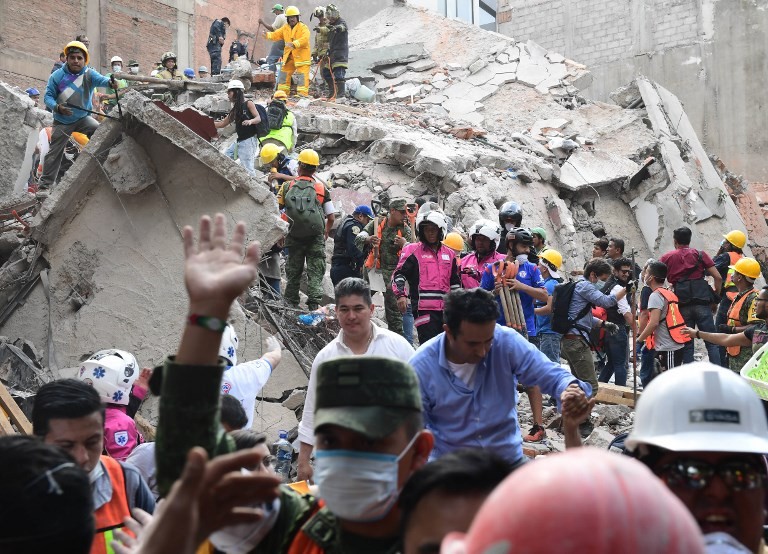
Nearly 140 people were killed when a powerful, 7.1-magnitude earthquake struck Mexico on Tuesday, toppling buildings in the capital and sowing panic on the anniversary of a devastating 1985 quake.
Rescue crews and volunteers in Mexico City -- home to 20 million people -- clawed through the rubble of at least 49 collapsed buildings looking for survivors and bodies.
Local media reported that families were getting Whatsapp messages pleading for help from desperate relatives trapped under the debris.
Mexico City recorded 36 of the deaths, while Morelos state directly south of it saw 64 killed. The others were registered in Puebla (29), a town southeast of the capital, and in Mexico state (nine), which lies just to the west of the capital.
National Coordinator for Civil Protection Luis Felipe Puente said a total of at least 138 people died.
Memories of the devastating 1985 earthquake that killed 10,000 people in Mexico City spurred panic on Tuesday. Many quickly ran for safety outdoors when walls around them swayed and cracked.
"I'm so worried. I can't stop crying. It's the same nightmare as in 1985," Georgina Sanchez, 52, sobbed to AFP in a plaza in the capital.
Amamia Sanchez, a 45-year-old secretary cried out: "It's just not possible that this happened also on September 19."
The quake -- which occurred in the early afternoon, hours after city authorities had conducted an earthquake drill -- caused damage in the bustling center of the city, and to areas south and west of the capital.
"We ran outside thinking all was going to collapse around us," said Lazaro Frutis, a 45-year-old who escaped an office building before it crumbled to the ground. "The worst thing is, we don't know about our families or anything."
"It was horrible," said resident Leiza Visaj Herrera, 27. "I didn't want to get close under any tree. I had to hold on to the ground."
Scenes of chaos permeated the city straight after the earth shuddered. Traffic jammed to a standstill before blanked-out stop lights, and anxious people ran between vehicles as ambulances tried to make headway, sirens squealing.
Emergency officials warned people in the streets to avoid smoking because of the risk of igniting gas leaking from ruptured pipes.
In several locations, people were seen clambering on buildings that were now piles of stone and tangled metal to pull people out.
Jorge Lopez, a 49-year-old Spaniard living in Mexico City, said that he raced to the school in the central Roma district where his children aged six and three were in class, to find it collapsed but his offspring safe but terrified.
"We arrived at the school and everyone was crying, everyone was frantic, and the kids were holding on to a rope," he said.
"It's uncontrollable. You can't do anything against nature."
Witnesses said another school was smashed to rubble in Cuernavaca, a town just south of the capital. The fate of the pupils and teachers was unknown.
An office building of around five stories in the chic Condesa district of central Mexico City collapsed. Volunteers scrambled among the debris, pulling out three survivors and looking for more.
"There are people trapped there!" yelled one woman.
Similar efforts were made at other smashed buildings nearby. At one, an emergency worker held up a sign commanding "Silence" so crews could listen for the sounds of any survivors.
Patients were evacuated from a hospital in the adjoining Roma district, wheeled out on beds and wheelchairs as staff set up makeshift wards outside.
President Enrique Pena Neto said on Twitter he had ordered the evacuation of damaged hospitals "and the transfer of their patients to other medical facilities."
At one collapsed building in the Roma district, dozens of people dug through rubble as they waited for the arrival of heavy machinery to move the massive chunks of stone. Officials called out for more volunteers, and for water.
A woman standing and watching the efforts with her husband, a doctor, turned to him and said, "Darling, if you want to help, give me your glasses and take care."
The city's international airport closed for more than three hours following the quake, and the stock market was forced to shut down.
Hours after the quake, residents stood around outside, in the streets, fearing aftershocks.
Direct Sentence to Indirect Sentence
1.  Direct: "I'm so worried. I can't stop crying. It's the same nightmare as in 1985," Georgina Sanchez, 52.
Indirect: Georgina Sanchez (52) said that she was so worried, She couldn’t stop crying and that it was the same nightmare as in 1985.
2.    Direct: Amamia Sanchez, a 45-year-old secretary cried out: "It's just not possible that this happened also on September 19."
Indirect: Amania Sanchez (45) told that it was just not possible that it had happened also on September 19.
3.  Direct: "We ran outside thinking all was going to collapse around us," said Lazaro Frutis, a 45-year-old who escaped an office building before it crumbled to the ground. "The worst thing is, we don't know about our families or anything."
Indirect: Lazaro Frutis (45) said that they had run outside thinking all was going to collapse around them, and that the worst thing was they didn’t know about their families or anything.
4.   Direct: "It was horrible," said resident Leiza Visaj Herrera, 27. "I didn't want to get close under any tree. I had to hold on to the ground."
Indirect: Leiza Visaj Herrera (27) said that it had been horrible, she had not wanted to get close under any tree and that she had had to hold on to the ground.


Ismadanti, Margaretha, Rahmaluttifah, Stacia
4SA01
PBIBK

Sabtu, 30 September 2017

Tugas 1 PBIBK: Direct Sentences

P.S: The direct sentences are highlighted in green

Nearly 140 killed in powerful Mexico quake 


Nearly 140 people were killed when a powerful, 7.1-magnitude earthquake struck Mexico on Tuesday, toppling buildings in the capital and sowing panic on the anniversary of a devastating 1985 quake.
Rescue crews and volunteers in Mexico City -- home to 20 million people -- clawed through the rubble of at least 49 collapsed buildings looking for survivors and bodies.
Local media reported that families were getting Whatsapp messages pleading for help from desperate relatives trapped under the debris.
Mexico City recorded 36 of the deaths, while Morelos state directly south of it saw 64 killed. The others were registered in Puebla (29), a town southeast of the capital, and in Mexico state (nine), which lies just to the west of the capital.
National Coordinator for Civil Protection Luis Felipe Puente said a total of at least 138 people died.
Memories of the devastating 1985 earthquake that killed 10,000 people in Mexico City spurred panic on Tuesday. Many quickly ran for safety outdoors when walls around them swayed and cracked.
"I'm so worried. I can't stop crying. It's the same nightmare as in 1985," Georgina Sanchez, 52, sobbed to AFP in a plaza in the capital.
Amamia Sanchez, a 45-year-old secretary cried out: "It's just not possible that this happened also on September 19."
The quake -- which occurred in the early afternoon, hours after city authorities had conducted an earthquake drill -- caused damage in the bustling center of the city, and to areas south and west of the capital.
"We ran outside thinking all was going to collapse around us," said Lazaro Frutis, a 45-year-old who escaped an office building before it crumbled to the ground. "The worst thing is, we don't know about our families or anything."
"It was horrible," said resident Leiza Visaj Herrera, 27. "I didn't want to get close under any tree. I had to hold on to the ground."
Scenes of chaos permeated the city straight after the earth shuddered. Traffic jammed to a standstill before blanked-out stop lights, and anxious people ran between vehicles as ambulances tried to make headway, sirens squealing.
Emergency officials warned people in the streets to avoid smoking because of the risk of igniting gas leaking from ruptured pipes.
In several locations, people were seen clambering on buildings that were now piles of stone and tangled metal to pull people out.
Jorge Lopez, a 49-year-old Spaniard living in Mexico City, said that he raced to the school in the central Roma district where his children aged six and three were in class, to find it collapsed but his offspring safe but terrified.
"We arrived at the school and everyone was crying, everyone was frantic, and the kids were holding on to a rope," he said.
"It's uncontrollable. You can't do anything against nature."
Witnesses said another school was smashed to rubble in Cuernavaca, a town just south of the capital. The fate of the pupils and teachers was unknown.
An office building of around five stories in the chic Condesa district of central Mexico City collapsed. Volunteers scrambled among the debris, pulling out three survivors and looking for more.
"There are people trapped there!" yelled one woman.
Similar efforts were made at other smashed buildings nearby. At one, an emergency worker held up a sign commanding "Silence" so crews could listen for the sounds of any survivors.
Patients were evacuated from a hospital in the adjoining Roma district, wheeled out on beds and wheelchairs as staff set up makeshift wards outside.
President Enrique Pena Neto said on Twitter he had ordered the evacuation of damaged hospitals "and the transfer of their patients to other medical facilities."
At one collapsed building in the Roma district, dozens of people dug through rubble as they waited for the arrival of heavy machinery to move the massive chunks of stone. Officials called out for more volunteers, and for water.
A woman standing and watching the efforts with her husband, a doctor, turned to him and said, "Darling, if you want to help, give me your glasses and take care."
The city's international airport closed for more than three hours following the quake, and the stock market was forced to shut down.
Hours after the quake, residents stood around outside, in the streets, fearing aftershocks.

Tugas PBIBK 1
Ismadanti Putri/ Margaretha Agustine/ Rahmaluttifah/ Stacia Dara
4SA01


Sabtu, 17 Juni 2017

JOB INTERVIEW (Tugas Softskill)

A job interview is a one-on one interview consisting of a conversation between a job applicant and a representative of an employer which is conducted to asses whether the applicant should be hired. Interviews are one of the most popularly used devices for employee selection. Potential job interview opportunities also include networking events and career fairs.
A job interview typically precedes the hiring decision. Besides, the job interview is considered one of the most useful tools for evaluating potential employees. The interview is usually preceded by the evaluation of submitted resumes from interested candidates, possibly by examining job applicants or reading many resumes. Next, after this screening, a small number of candidates for interview is selected.(https://en.wikipedia.org/wiki/Job_interview)

There are several types of question that usually asked by the employers to the interviewees. The type of questions asked can affect the interviewees reaction. Some of the common questions on the mind of the employer include:
1. Tell me about yourself.
2. Do you have any health problem? have you ever been hospitalized?
3. What do you think are your greatest strengths and weaknesses?
4. How would you describe your personality?
5. Have you ever working under stress?
6. When did you last lose your temper? Describe what happened.
7. Do you regard yourself as an ambitious person?
8. What is more important to you: status or money?
9. What excites you about the job you are doing now?
10. What worries you about the job you are doing now?
12. How long do you think you'd stay with us if you were appointed?
13. How do you like your present job?
14. What are your most proud of having done in your present job?
15. What was the worst problem you have had in your present job?
16. Why do you want to leave your present job?
17. What do you think an ideal boss is like?
18. How often were you absent from your previous job?
19. Why should we hire you instead of the other candidates?
20. What sort of salary are you looking for?


However, in many countries, law are put into place to prevent organizations from engaging in discriminatory practices against protected classes when selecting individuals for jobs. In the United States, it is unlawful for private employers with 15 or more employee along with state and local government employers to discriminate against applicants based on the following: race, color, sex (including pregnancy), national origin, age (40 or over), disability, or genetic information (note: addition classes may be protected depending on state or local law). More specifically, an employer cannot legally "fail or refuse to hire or to discharge any individual, or otherwise discriminate against any individual with respect to his compensation, terms, condition, or privilege of employment" or "to limit, segregate, or classify his employees or applicants for employment in any way which would deprive or tend to deprive any individual of employment opportunities or otherwise adversely affect his status as an employee". (https://en.wikipedia.org/wiki/Job_interview)

Given these laws, organizations are limited in the types of questions they legally are allowed to ask applicants in a job interview. Asking these questions below may cause discrimination against protected classes. For example, in the majority of situations, it is illegal to ask the following questions in an interview as a condition of employment:

1. Do you have any physical or mental disabilities?
Such question is illegal because it is unlawful for an employer to discriminate against a qualified applicant or employee with a disability.

2. When are you planning to have children?
This question classified into illegal question because sex is a federally protected class, which means an employer cannot discriminate against a male or female job applicant.

3. Will you need time off for religious holiday?
Religious discrimination is strictly prohibited. That is why such question is illegal to be askes in an interview. Employers are not allowed to make hiring decisions based on a person's religious beliefs, observance, or practices.

4. What is your nationality?
This is an illegal question because national origin is a federally protected class. Consequently, employers cannot base hiring decisions on whether an applicant is from a different country or of a specific ethnicity.

5. What is your political affiliation?
Political affiliation is a personal preference and is a private thing. Everyone have freedom to choose what party they are supporting. That is why employers should not discriminate applicants against their political affiliation.

Then, how to answer those illegal questions?
When an interviewee is asked illegal questions by the employer, He or She is always have the option to refuse to answer the questions or to answer the questions politely. For example, when a question about physical or mental disabilities comes out, you can answer to it politely by saying that you are confident that you will be able to handle the requirements of the position you applied to.
Also, when you are asked questions such as what is your nationality, what is your political affiliation, when are you planning to have children, or will you need time off for religious holiday, you can answer to those questions by saying that you are confident that those things (nationality, political affiliation, children, and your religious belief) will not interfere with your ability to do the job.


General questions are viewed more positively than situational or behavioural questions and 'illegal' questions may be perceived as negative being unrelated to the job, unfair, or unclear how to answer. Using questions that discriminating unfairly in law unsurprisingly are viewed negatively. The applicants also less likely to accept a job offer, or to recommend the organization to others.


SOFTSKILL GROUP ASSIGNMENT #8
Asri, Ismadanti, Margaretha, Rahmaluttifah, Stacia, Talitha
3SA01

Sabtu, 20 Mei 2017

(Tugas Softskill) Curriculum Vitae & Application Letter

My curriculum vitae and application letter in the form of picture

P.S: click on the picture for a better view

Curriculum Vitae:


Application Letter:


Rahmaluttifah//3SA01

Sabtu, 13 Mei 2017

(Tugas Softskill) Negotiation


What is Negotiation?
Negotiation is a method people use to settle differences. In order to avoid argument and dispute, negotiation is needed to reach the agreement. There will be a negotiation process when each related people have different opinions, here, negotiation will play an important role to find out the best solutions of all.

What are the Negotiation Styles?


1.     Avoiding
This negotiation style is concerned with avoiding intra-personal conflict. It is characterized by sidestepping, postponing, and ignoring the issue or situation. This style of negotiation will be useful when the stakes of a negotiated outcome are not worth the investment of time or the potential for igniting conflict
2.     Accommodating
This negotiation style is concerned with the relationship between the parties. In this style of negotiation, the other side will be easily given concessions in hopes of strengthening the relationship, also will be very thoughtful to the other side which make them to be neglected their own needs, this is because they want to help the other side to get what they want
3.     Compromising
This style is in between accommodating and competing. It will be very useful to use this style when time is a concern or there is a strong relationship between the parties. In order to reach an agreement, this style need concessions from both sides. “Meet in the middle” or “Split the difference” solutions are used in this style.
4.     Collaborating
This style focuses on using problem solving methods to create value and discover mutually satisfactory agreements. Utilizes the creativity of both parties to find solutions to both sides’ interests. This style teds to be assertive about their need and cooperative with the other side.
5.     Competing
This style concerned with achieving their own goals regardless of the impact on others. This style is when one side wants to win the negotiation and the winning will make the think superior than the other side. Negotiation is viewed as a win or lose competition rather than a problem solving activity. In order to achieve their objectives, manipulative tactics such as attacks and threats are often used in this negotiation style.

Negotiation Process

In order to achieve a successful negotiation, a certain approach to negotiation is needed. The negotiation process includes the following steps:
1.     Preparation
The first step is to prepare everything that is needed to do the negotiation. This involves making sure all the pertinent facts of the situation are known in order to clarify your own position. Furthermore, before the negotiation is held, a decision needs to be taken as to when and where a meeting will take place to discuss the problem and who will attend.
2.     Discussion
During the discussion, the representatives of each side pouring their understanding of the situation and discuss it together. It will be helpful to take notes during the discussion or record the whole discussion just in case a clarification will needed in the future.  
3.     Clarifying goals
Each sides must clarify their goals. From the discussion, the goals, interests, and viewpoint of both sides need to be clarified thus future misunderstanding can be avoided. It is helpful to make a list of these things (goals, interests, and viewpoints) in order of priority. This clarification is a way to identify or establish some common ground.
4.     Negotiate Towards a Win-Win Outcome
This stage focuses on seeking for the most comfortable solutions both sides, or win-win outcomes, where both side feel they have gained positive things from this whole negotiation process. Win-win outcome is usually the best result of negotiation. Win-win outcome will be achieved if each of the point of view of both side has been taken into consideration.
5.     Agreement
Agreement can be achieved once all the things that is being negotiate has been cleared and both side feel satisfied with the outcomes. It is essential for everybody involved to keep an open mind in order to achieve an acceptable solution.
6.     Implementing a Course of Action
Based on the agreement, a course of action has to be implemented to carry through the decisions.

What are the Characteristics of Negotiation?

The characteristics of a negotiation are:
1.      There are minimum of two parties involved in a negotiation
2.  Nearly always in the form of face-to-face use of spoken language, gestures and facial expressions.
3.     Negotiation usually concerns things in the future that will come or has not happened and the negotiator wants to happen. Both parties have their own goals that they wish to achieve through the negotiation
4.      There is a clash of goals, that is, some of the goals are not shared by both parties
5.      There is an expectation of outcome by both 
parties in negotiation
6.      Both parties believe the outcome of the negotiation to be satisfactory
7.      Both parties are willing to compromise
8.      Both parties understand the purpose of the negotiation
9.      The end of the negotiation is the agreement taken by both parties, although the agreement is for example both parties agree to disagree.

Effect on Negotiation


A.     Positive effect
ü  In procedural terms, negotiation is probably the most flexible form of dispute resolution as it involves only those parties with an interest in the matter and their representatives. Like any method of dispute resolution, negotiation cannot guarantee that a party will be successful. However, many commentators feel that negotiations have a greater possibility of a successful outcome.
ü  The advantages of negotiation are that it limits the number of players to those involved in the dispute. This allows for a focused approach to problem solving.
ü  Assuming that the parties are negotiating in good faith, negotiation will provide the parties with the opportunity to design an agreement which reflects their interests.
ü  Negotiations may preserve and in some cases even enhance the relationship between the parties once an agreement has been reached between them.

B.     Negative effect
û  A particular negotiation may have a successful outcome. However, parties may be of unequal power and the weaker party (ies) may be placed at a disadvantage.
û  Where a party with an interest in the matter in dispute is excluded or inadequately represented in the negotiations, the agreement's value is diminished, thereby making it subject to future challenge.
û  No party can be compelled to continue negotiating. Anyone who chooses to terminate negotiations may do so at any time in the process, notwithstanding the time, effort and money that may have been invested by the other party or parties.
û  The negotiation process cannot guarantee the good faith or trustworthiness of any of the parties.
û  During the negotiations, in conveying the intentions sometimes there are any arguing with emotion that make the other party angry. Thus, it can lead to split both sides, damage business relationships and, be difficult to negotiate and make a deal in the future.


SOFTSKILL GROUP ASSIGNMENT #6
Asri, Ismadanti, Margaretha, Rahmaluttifah, Stacia, and Talitha

3SA01